
Introduction:
I have put together the following Frequently Asked Questions page in order to answer some of the questions that we are often asked. I sincerely hope it is a useful source of information for you. If you feel there is something missing, or if you have something to add, please feel free to email me at william@bunburyboards.com.
Thank you.
![]()
William Bunbury,
Managing Director
Where can I find the Tree Report for my Bunbury Board?
I am having problems opening the Tree Report
My Tree Number (Log Reference) is “not recognised”
Can I choose the species of wood for my Bunbury Board when I order online?
How much is delivery and how long does it take?
I’ve lost the Care Instructions that came with my Bunbury Board – what did they say again?!
What is the best way to clean my Bunbury Board?
My board has got stained somehow
Can wood move, crack, split, twist, warp or curl?
What oil(s) should I use for my board, and how?
Where does the wood for Bunbury Boards come from?
Who makes the Bunbury Boards?
What species of woods are Bunbury Boards made from?
What is the definition of "hand crafted"?
Do you replant trees?
Is yew poisonous?
What does "waney edged" mean?
What processes does the timber go through before becoming a Bunbury Board?
How dry is the timber in a Bunbury Board?
What are the beautiful markings in the wood of my board?
Wood versus plastic cutting boards
Where can I find the Tree Report for my Bunbury Board?
The log reference is a 6 digit code stamped onto the back of your Bunbury Board.
Click on the "Your Tree Report" tab, towards the top right hand corner of this screen and follow the simple instructions. The same tab is available on all screens on our online shop.
To access your tree report on the main Bunbury Boards website, click on the "Bunbury Owners World - View Your Tree Report" at the top of the screen and follow the simple instructions there.

I am having problems opening the Tree Report
Reasons that you might be having difficulties accessing your Tree Report include not having Adobe Reader installed on your computer, pop-up settings on your browser, unusual email addresses (see below), compatibility issues between some operating systems & programmes or other technical issues. But please don’t throw your computer (or Bunbury Board) out of the window just yet!
Regarding email address problems, we understand that our flash based page on the main website can have a problem dealing with email addresses that have two “dots” in them. (For example jsmith@something.somethingelse.com). However, the “Tree Report” tab at the top right of this page will lead you to a non-flashed based version of the access point to your tree report, and this should work for this type of email address.
Whatever your problem might be, if you send us a quick email to feedback@bunburyboards.com, mentioning the log reference at the back of your Bunbury Board, we can send the Tree Report to you by return email. Any information you are able to give us about the problems you were experiencing with the “normal” method of downloading Tree Reports would be gratefully received and may help us all in the future.
My Tree Number (Log Reference) is “not recognised”
If you get this message it is possible that the details of the tree from which your Bunbury Board was produced have not been uploaded to our online database yet. This is a rare oversight on our part and easily rectified. Please let us know, as you are probably not the only Bunbury Board owner facing this problem! Email us at feedback@bunburyboards.com and we'll update the database. We will also get back to you by return with a copy of your tree report.
Don’t forget to mention the log reference on the back of your Bunbury Board in your email!
Can I choose the species of wood for my Bunbury Board when I order online?
If you have a preference for a particular species, please let us know and we will do our best to accommodate you. (You can also give us 2nd, 3rd, 4th, etc choices.) We do not carry boards of all styles and sizes in all species at once – it’s simply not possible. If you do not state your preference we will choose what we believe to be the most appropriate species of board for you. To get an idea of the wood species that we work with, see “What species of woods are Bunbury Boards made from?” below.
How much is delivery/shipping and how long does it take?
To get an estimate of shipping and tax, click on “My Cart” (after you have added something to it) and enter the destination in the form at the bottom left. Click “Get a quote” and the cost of shipping is calculated for you.
[Delivery times?]
In simple terms, wash spillages and debris off your Bunbury Board quickly and keep it well oiled.
I’ve lost the Care Instructions that came with my Bunbury Board – what did they say again?!
|
Care instructions Wood is an excellent choice for chopping boards, placemats and platters as timber contains its own (mild) antibacterial properties and is more resistant to bacteria than plastic. It is also kinder to your knives, leaving them less likely to become blunt. To maintain and clean your board: Wipe down with warm soapy water and allow to dry naturally. Do not immerse in water or wash in a dishwasher. Do not place near direct heat Wood is a natural product and so movement or cracking may occur. Periodically wiping your board with Bunbury oil and a soft cloth will assist in protecting and maintaining it. |
See below for more detailed instructions.
What is the best way to clean my Bunbury Board?
Do not submerge your board in water.
Do not put it in a dishwasher, place it in a microwave or near any direct heat.
Wipe clean with a clean cloth, sponge or paper towel using water and mild detergent or vinegar.
Wipe excessive moisture from board and allow it to dry naturally standing on its side or end.
Do not rest your board behind the sink as splashing water will soak into the board causing it to be come wet through.
For more stubborn problems (such as dried on tomato pips, dried out cheese or other mysterious ingredients), dab on some soapy water over the area affected (only) and leave it for a few minutes to soak. Do not soak the whole board. Then wipe off as above. If necessary, use a scouring sponge, but be careful not to scratch the surface of your board if using a particularly harsh scouring sponge.
Once you’ve done this a couple of times, you will begin to realise that it is much easier to clean your board if you clean it “on the go”, rather than leaving it for a few hours!
Once the board has dried off, check to see if the wood looks dry or “thirsty”. If so, apply some oil. (Click here for more information on oiling your board)
My board has got stained somehow!
Over time, stains may soften and become less noticeable – or maybe we just get used to them and accept them – but when they first occur it seems disastrous!
Liquid stains
Liquids can penetrate the wood and, especially if left for a while, can leave a stain within the wood itself rather than just on the surface.
A number of methods can work, depending on the nature of the stain:
Scorch marks
Light scorch marks can sometimes be removed by wiping with methylated spirits. Heavier scorch/burn marks may have to be sanded out. Re-oil the board afterwards.
Black pot stains
These are black stains or ring marks that “suddenly appear” on wooden surfaces in kitchens, particularly oak surfaces. They can be very hard to remove. Rather than being burn marks in the wood, which can be the initial impression, these black marks are usually caused by a chemical reaction between water, metal (especially iron) and wood tannins. Chopped/sliced potatoes can also cause this staining. The stain goes into the timber itself, rather than just lying on the surface.
I have tried a few experiments, including the use of vinegar, baking soda/bread soda, toothpaste, lemon (all as mentioned above under “Liquid stains”). The one combination that definitely worked for me on the oak worktop in our kitchen - which had several black ring marks in it from the kettle, pots or lids off the stove - was a mix of bread soda (bicarbonate of soda) and lemon juice:
Sprinkle the bread soda over the stain.
Squeeze a lemon over the bread soda (it will fizz up).
Using your finger, mix into a paste and make sure the affected area is well covered.
Leave for 5 to 10 minutes.
Scrub the stain.
The stain gradually eases out of the wood.
Afterwards, give the area a really good wash with water or vinegar and allow it to dry out.
Finally, apply at least one coat of oil to restore your board back to normal.
This method worked well. The oak was slightly darker in colour afterwards, but this faded back to it's normal colour after a few days.

Alternatively, it may be necessary to sand the stain out. This will definitely work, but will take a few minutes of elbow grease (or use a small mouse sander, if you have one – they’re not very expensive). You can use a fairly coarse grit to start with (e.g. 60 or 80 grit sandpaper) for deep, stubborn stains. Once the stain has disappeared, or for lighter stains, use a finer sandpaper (180 to 240 grit) to finish the surface nicely before re-oiling the board several times.
Oxalic acid can be used to remove stains very effectively, although it is toxic. (Oxalic acid occurs naturally in black tea, chives and rhubarb leaves and in relatively high concentrations, although you’d need to eat about 4 or 5 kg of rhubarb leaves in one go for it to have lethal effect – see http://www.oxalicacidinfo.com/.) If using oxalic acid, wash the board very thoroughly, neutralise the wood with baking soda and re-oil the wood several times.
Stain prevention:
Can wood move, crack, split, twist, warp or curl?
Wood always moves depending on changes to its immediate environment, such as temperature or humidity. Under normal circumstances your board should remain relatively flat and intact.
Sufficient fluctuations in the moisture content of timber can cause it to warp, cup or even split. This can also occur if the board has been soaked in water and dried rapidly. Never soak your board for more than a couple of minutes or place it in the dishwasher. Damp cupboards can also cause problems over a period of time.
Solutions:
Using the same side of a cutting board again and again inevitably means that one side is getting cleaned more than the other. Two possible outcomes of this are that either the “top” side is cleaned so often that the oils are removed and the board dries out so much that it shrinks on the top side (causing the sides of the boards to rise), or the moisture from cleaning the board soaks into the wood so that it swells (causing the centre of the board to rise along the grain). Try using both sides of your board equally frequently, keeping the board cleaned and oiled regularly.
Sometimes cupping/curling/warping can be fixed by simply turning the board over onto the cupped side and leaving it to rest for several days. Boards often straighten again using this method. If the board was accidentally soaked for too long, let it dry our properly - either leave it standing vertically or lying flat over a flat surface in at room temperature for a week or two. Even cracks can "disappear", or at least become considerably less noticeable in this way.
If you would like further advice on your board, please email us at feedback@bunburyboards.com with a brief description of the problem and, ideally, a photograph of the board, and we will get back to you by return.
What oil(s) should I use for my board, and how?
There are several oils that you can use. A light food-grade mineral oil is probably the most commonly recommended oil. Good oils for your board include walnut oil, poppy seed oil, linseed oil, boiled linseed oil, lemon oil (actually lemongrass oil) and sesame (seed) oil.
Many suggest that it is not wise to use vegetable oils, such as sunflower oil or olive oil, as it can go rancid in the wood. There must be examples of it going rancid or people wouldn’t be talking about it, although, personally, I have used olive oil several times in the past and I have never had this problem.
Do not use oils with solvents (e.g. Danish Oil), unless you are familiar with such products, you know how to use them and you know how long it takes for the solvents to evaporate.
Apply oil regularly or especially when the wood looks “thirsty” and has that dry, washed out look to it. (Cleaning your board inevitably removes some of the applied and naturally occurring oils from the wood). After you have oiled your board a few times, you will understand more about how often it makes sense to apply oil. It will vary depending on the species of wood and the amount of use the board is getting, but as a general rule you should oil your board every month or two.
Using a soft cloth, rub the oil into the wood leaving a small amount on the surface for two or three minutes. You will probably be able to see this surplus oil being “sucked” into the wood if your board is particularly dry in some areas (in which case your board definitely needs the oil!). After a couple of minutes, wipe the surface clean of any surplus oil using a clean soft cloth.
Where does the wood for Bunbury Boards come from?
Much of the wood we use comes from the trees growing in our own 200 acres of mainly woodlands on our farm at Lisnavagh, Rathvilly, Co Carlow. From time to time, we have brought wood in from other farms and estates around the country. But without exception, all of the wood used to make any of our products comes from trees that were growing on the island of Ireland.
Not only do we source all of our timber from Irish sources, but we also try to use Irish suppliers as much as possible. Our ribbons, labels, printing, packaging, oils and many tools are from Irish suppliers. Even the metal spikes for our Carving Boards are made locally in Co Carlow.
Our production team in our workshop here at Lisnavagh, Rathvilly, Co Carlow, Ireland make all our Bunbury Boards and any other products & commissions. The employees live locally.
These are 100% Irish-made products.
What species of woods are Bunbury Boards made from?
All sorts! We deliberately try to produce our boards in as wide a range of species as possible to give you as great a choice as possible. Peoples’ tastes vary enormously, as we have discovered, and so we provide as wide a variety of shapes, sizes and species as we can.
The most usual and popular woods that we use include oak, ash, elm and beech (including spalted beech). Often we can produce boards in walnut, birch and sycamore. More unusual would be boards made from yew or laurel.
What is the definition of "hand crafted"?
A good question! And one that is hard to answer. “Hand crafted”, “Handmade” and “Hand finished” do not mean that the item in question was necessarily shaped and finished by hands and fingernails alone. Clearly if you pour various materials into a hopper and out pops a mousetrap or an aeroplane, then the product is far from handmade. But where does one draw the line? If you search the internet for definitions about this (as I have just done), you will see that the jury is out on this subject.
So, I’ll tell you what we do, and what we may do in the future, and you can decide if you are happy with our definition of “hand crafted”
As well as the hands of our wonderful woodworkers, we do use machines to make Bunbury Boards, but that should not surprise you. Before the timber arrives in the workshop, it has seen the use of chainsaws, sawmills and a kiln. However, once in the workshop, it is our woodworkers who examine each plank carefully to decide which planks are most suited to each product we make. They are planed down in our workshop using a planer thicknesser, but it the woodworker’s eyes, ears and fingers that know when the machine has done its job. Next, the woodworker uses a template and pencil to draw the rough shape of the Bunbury Boards onto the plank, making sure to get the best possible look and stability to each one. The “blanks” are cut out using a table saw. The curved corners are cut out on a band saw with the woodworker’s careful guidance. A hand-held router (a dangerous tool) is used with great caution to rout out handles, finger plates, drainage grooves, wells and to bevel edges. A table sander is used to polish the board’s main surfaces down before the hand-held belt and orbital sanders are used for a finer finish. After that, the woodworker gives the board a final going over with a piece of even finer sandpaper by hand. The board then goes through to our dust-free zone where it is oiled, stamped with its tree number, ribboned up and labelled (all by hand). We believe that is hand made. You can see it all on You Tube: (http://youtu.be/K0OZYthVHxw).
One of our boards, The Carving Board, involves 14 changes of router bit during its production. This is time consuming and has the potential to allow mistakes to be made. Using a CNC (computer numerical control) machine would allow us to reduce the time and risk. Although we haven’t got one at the time of writing (January 2012), it is likely that it will make sense very shortly. This will mean that a computer is in charge of cutting the drainage grooves, gravy well and the slot for the metal disk. But all other operations will continue to be “by hand”.
The following came from an article by someone called Lou Radecki:
“… with all the variables possible, all the terms "handmade", "handcrafted" "handicraft" and "hand finished" can possibly mean is that some part of the process has the mark of an individual human being. And that the final item cannot be exactly duplicated, and is therefore, one-of-a-kind. But the line is drunken blurry, and subject to individual interpretation.”
For the full article see http://www.articlecity.com/articles/marketing/article_4789.shtml
In a word, yes! Our woodlands at Lisnavagh are constantly managed. They were planted by my ancestors for aesthetic and sporting reasons, mainly in the 19th century. We love the way our woodlands look & feel and we aim to keep them that way.
Our woods are ever-evolving – some trees thrive, some fail. Most withstand the severest gales, some do not. Diseases come and go, some more serious than others. Dutch elm disease sadly wiped out all our mature elm trees a few years ago and the threat of Sudden Oak Death looms too close for comfort. In between all of that, we sometimes get out our chainsaws to take down a tree so that others might have a better future (thinning) or even a few trees so that we have a big enough area to be worth under-planting with new trees.
Do we always replant? Usually, yes – but not always.
Sometimes a tree has been felled because it is too close to a house or it presents some other danger and replacing the tree would be defeating the object of felling it in the first place.
Sometimes “natural regeneration” or self-seeding of trees beats us to it. In other words, seeds from the tree that has fallen or neighbouring trees have germinated and a perfectly good tree has got off to a good start. I prefer to leave that tree to grow on (especially if it’s from good stock).
Otherwise, it makes sense to buy in trees of good provenance and plant them – and we do this every year. Numbers planted vary from a few hundred to a few thousand each year.
The species we replant include mainly oak, ash, beech. Also birch, cherry, lime, chestnut, walnut and other hardwoods. Occasionally we plant softwood/conifer species too. Naturally regenerating species at Lisnavagh include oak, ash, beech, sycamore, elm, chestnut, birch and several softwoods.
We expect the owners of other woodlands (or farmland, even gardens) from whom we occasionally obtain timber to follow the same policies as we do.
First of all, toxic substances are found in many plants that we come across every day. For example, cyanogenic glycoside is found in apple seeds, cassava roots and leaves, the leaves and seeds of cherries, plum, peaches, almonds and apricots. Poisons can also be found in onions, garlic, rhubarb, tomatoes and potatoes. Don’t stop eating these! These toxins either exist in very small amounts or in parts of the plant that we don’t eat (e.g. rhubarb leaves, green potatoes, tomato leaves, etc) or are broken down by cooking. If you really tried hard enough, you could probably kill yourself with any of these but it would take a pretty determined effort.
There is a poison found in yew trees, called taxane. It is in all parts of the tree (except, apparently, for the fleshy part of the red fruit surrounding the very toxic seeds). It is estimated that 50 to 100 grams of the leaves – which I am guessing is about 4-6 tablespoons of crushed/liquidised leaves – or the seeds from about 30 berries might be enough to cause an adult human fatality, so quite a lot. And probably not that tasty either.
But is the wood itself poisonous? If so, how poisonous? Some say it is fine, and have spent decades drinking from yew goblets and eating off yew plates. There are also many doubters out there – “If in doubt, don’t do it” advice is all over the web if you do a search. So, I cannot answer the question categorically, but it seems to me that there is a consensus of opinion on a couple of points:
1 - 50 to 100 grams of leaves represent a fatal dose
2 - The wood is less poisonous than the leaves
Therefore, it would presumably require the consumption of at least 50 to 100 mg (4 to 6 tablespoons) of wood to get a fatal dose of taxanes…? I haven’t tried eating that much wood myself.
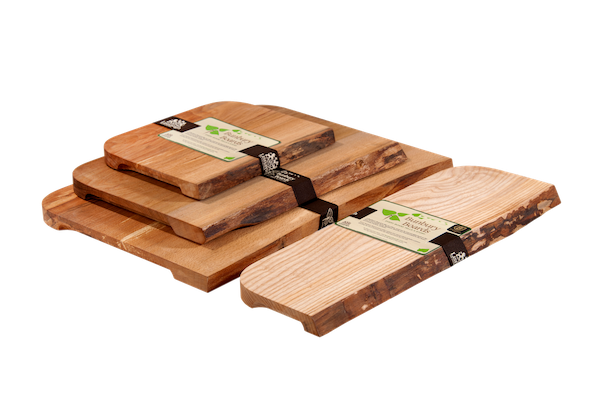
Waney edged is a description of a board where (usually) one side of a board is sawn square and the other side is not sawn at all, thus retaining the edge of the tree, or wane. This type of board might be used, for example, by a woodworker who wants to give a rustic and uneven appearance to an item he is making.
Generally at sawmilling, boards can be cut as “square edged” boards, “waney edged” boards or as “through-and-through” boards (i.e. waney edged on two sides).
What processes does the timber go through before becoming a Bunbury Board?
This could take a long time to answer in detail! However, in summary, the processes include:
Finding suitable trees
Before anything can happen, suitable trees need to be identified. Often, we find that trees have come down in high winds or sometimes they have died standing as a result of disease. Occasionally, a tree has to be felled because it poses a danger to a house or road. As part of our good woodland management practice, we will fell some trees to allow better trees to grow on to maturity or so that we can create a large enough opening in a woodland to allow for it to be under planted with young trees. All of these things happen anyway. When they do happen, I or another member of the team here evaluate each tree to see if we deem it to be of interest to the Lisnavagh Timber Project. If so, details of each tree and photographs are recorded onto our database – the first step in our traceability system.
Tree felling
For trees that need to be felled for some reason, we use a qualified tree surgeon or forester. It often makes sense for the tree to be "dismantled" first. In other words, the branches are removed from the tree - this minimises damage to the main stem when it is felled. Using chainsaws, wedges, winches and/or ropes the tree is then felled in a safe direction.
Tree planting/replanting
Whenever a tree comes down at Lisnavagh, we replace that tree. If it is not reasonable to replant one or more trees on the same spot, then several trees are planted elsewhere instead. Anyone supplying timber to us from outside Lisnavagh is expected to adopt the same policy.
Tree jointing
After the tree has fallen, it is marked up for “jointing” which is the process of cutting logs from the trunk and branches. These logs are generally separated into commercial logs for planking, lesser logs for fencing stakes or beams and firewood.
Extraction
Logs are extracted from woodlands to roadside using tractors, horses, winches or forwarders.
Transport to sawmill
Using log transporter lorry, tractor and trailer or jeep and trailer.
Sawmilling
Logs are sawn into planks of desired thicknesses using (usually) a mobile bandsaw mill operated by a contractor in our sawmilling yard at Lisnavagh. As each plank comes off the sawmill it is measured, graded, given a unique reference number and its details are also recorded onto our database.
Air drying
The planks are stored under cover for at least a year until they are “air dried” (c. 20% moisture content) to the centre. As a rule of thumb 1” planks take one year, 2” planks take 2 years, 3” planks take 3 years, etc.
Kiln drying
The planks are placed in one of our dehumidifier kilns (or “seasoners”) for 2 to 7 weeks (depending on thickness and species) to dry down to 10% moisture content. The temperature is kept at 35°C to 40°C.
Storage & Selection
The kiln dried planks are stored in a “Dry Room” – a climate controlled section of our main building. From here, the planks are selected for conversion in the workshop.
Manufacture of products and commissions
In the workshop, depending on the final product, the boards are planed down to the required thickness using a planer thicknesser, ripped to the required width and cross cut to the required length. The reference number of the plank is recorded (to ultimately give the log reference of the tree it came from). Sometimes boards are joined together for larger product (using a biscuit joiner or spindle moulder). Any drainage grooves, wells, finger plates, etc are carved into the board using a hand held router. Further shaping of the boards is carried out, for example using a bandsaw. The edges of boards are often rounded over using a router or spindle moulder. Holes may be drilled through using a pillar drill. A table sander is used to give the board a basic sanding before hand held belt & orbital sanders are used to give the boards a finer finish. Ultimately, the boards are often given a final finish using hand held sandpaper.
The boards are then brought into a dust-free zone for oiling. They are stamped with the log reference of the tree from which the board came. Ribbons and labels are applied. At this point the boards are either packed into a box for immediate delivery or retained in stock for future orders.
For a more detailed look at the processes that the timber goes through at the Lisnavagh Timber Project (where we make the Bunbury Boards), please take a look at the “What we do” section of our sister site: http://www.irishwoods.com/about/whatwedo.
How dry is the timber in a Bunbury Board?
The timber used is kiln-dried down to 10% moisture content (+/- 2%).
What are the beautiful markings in the wood of my board?
There are many possible explanations for unusual colourings and patterns within wood. Spalted beech is probably the most commonly occurring colouration found in our boards. The effect ranges from slight colouration of the board (“flaming”) through to intensive and strongly contrasting colours, including blacks, reds, greens and almost whites. This usually happens in beech but can occur in other species and it is caused by fungi as a result of deterioration in a tree’s health. Colouration can also be caused by minerals in the ground where the tree was growing. Interesting patterns can be caused by the way the tree was growing, burrs or epicormic growths on the side of the tree or natural patterning inherent in a particular species. Also common are the medullary rays visible in quarter sawn oak and other species.
When selecting trees and timber, a particular effort is made to try and find interesting timber with as many such features as reasonably possible.
Wood versus plastic cutting boards
Wood is an excellent choice for chopping boards as timber (unlike any other cutting surfaces) contains its own antibacterial properties (anti microbial chemicals), thus making it more resistant to bacterial growth that plastic. Detailed studies have been carried out by the university of California in the US that positively prove that plastic chopping boards, once used (i.e. knife scarred) are technically impossible to clean manually as food residue within the knife scarred cracks allows bacteria to grow and multiply. This is unlike in timber where bacteria tend not to multiply and eventually die
Timber chopping boards are also kinder to your knives. Alternative surfaces such as glass or metal will, over a short time, cause your knives to become blunt.